About
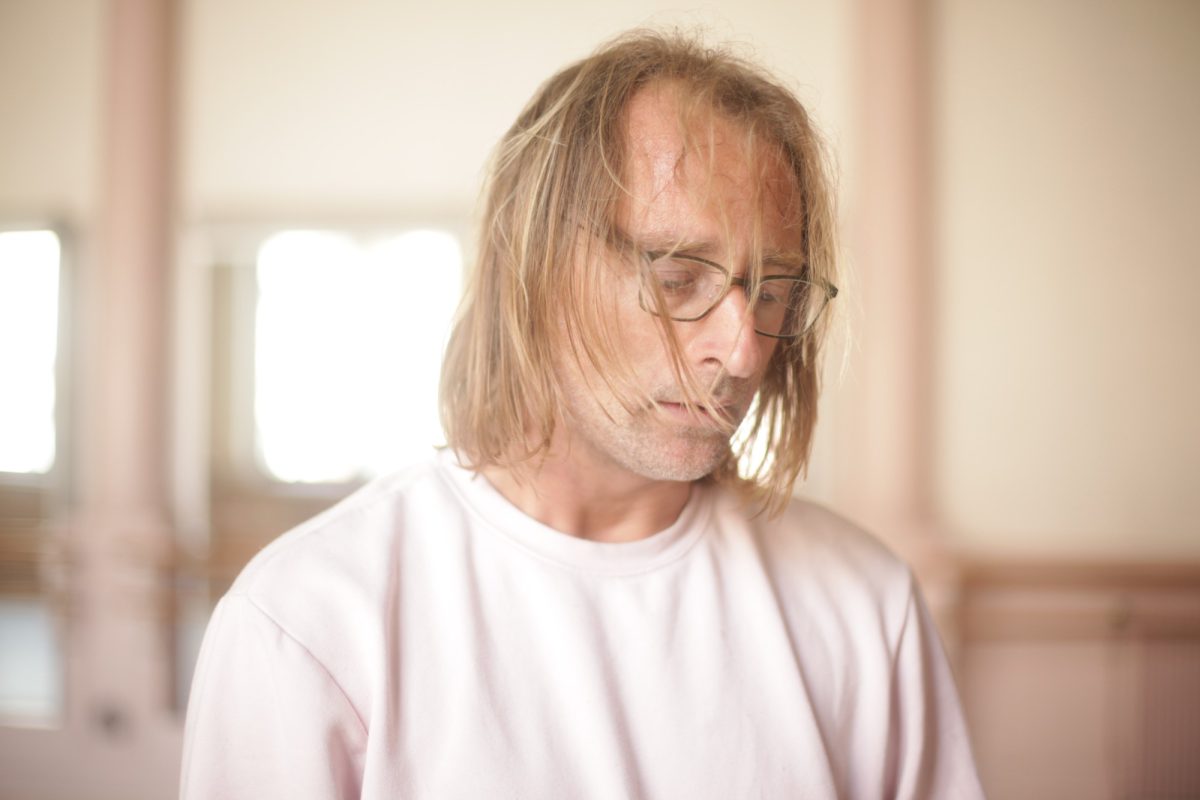
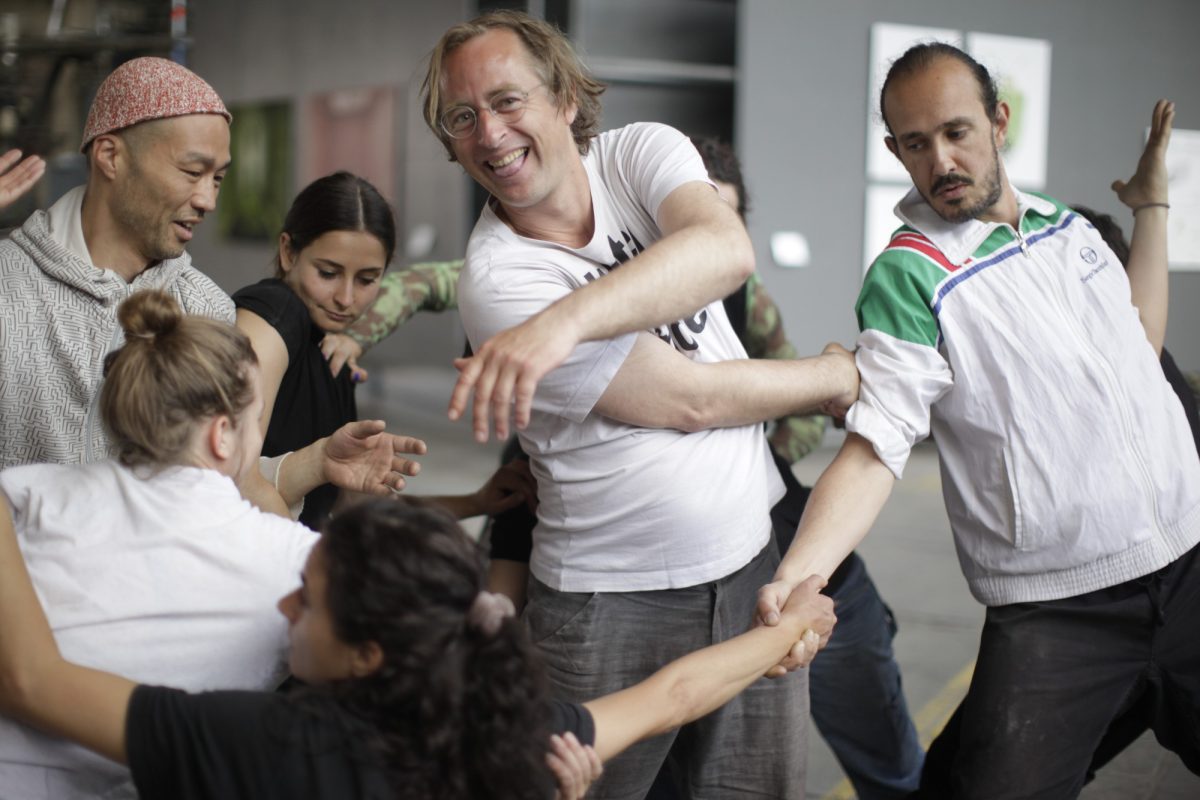
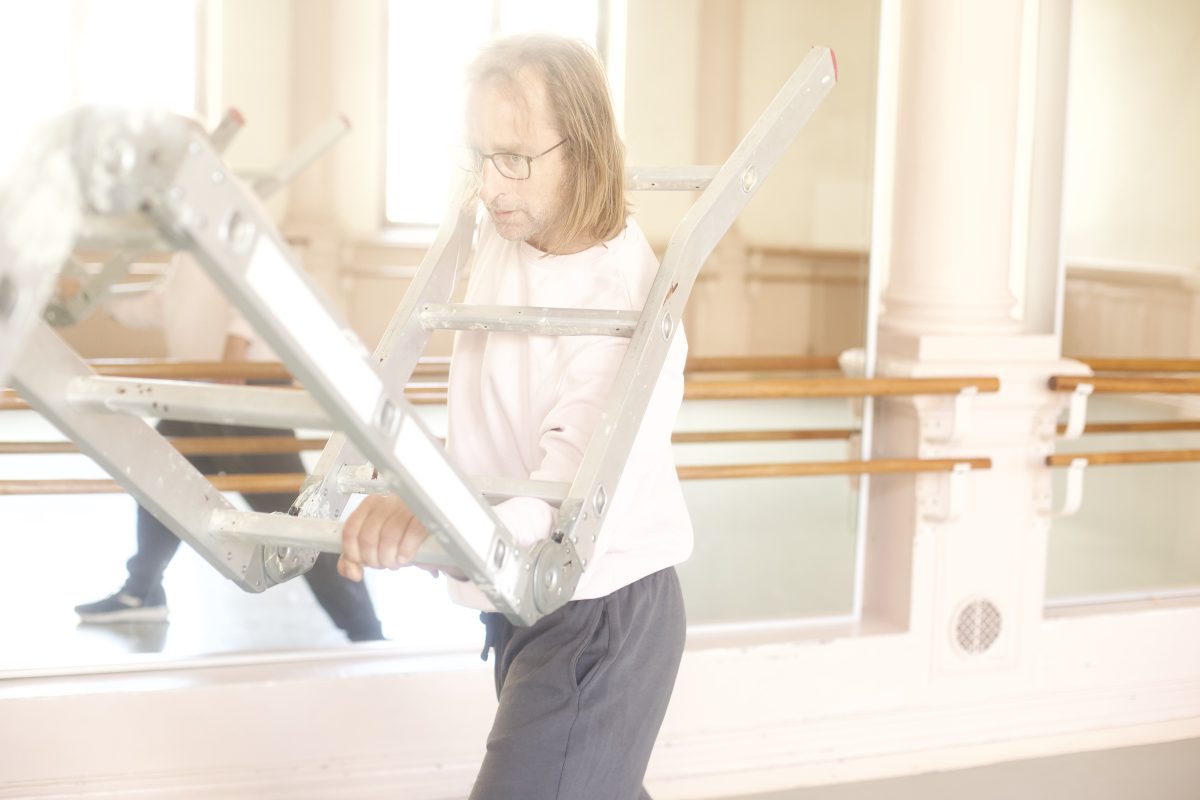
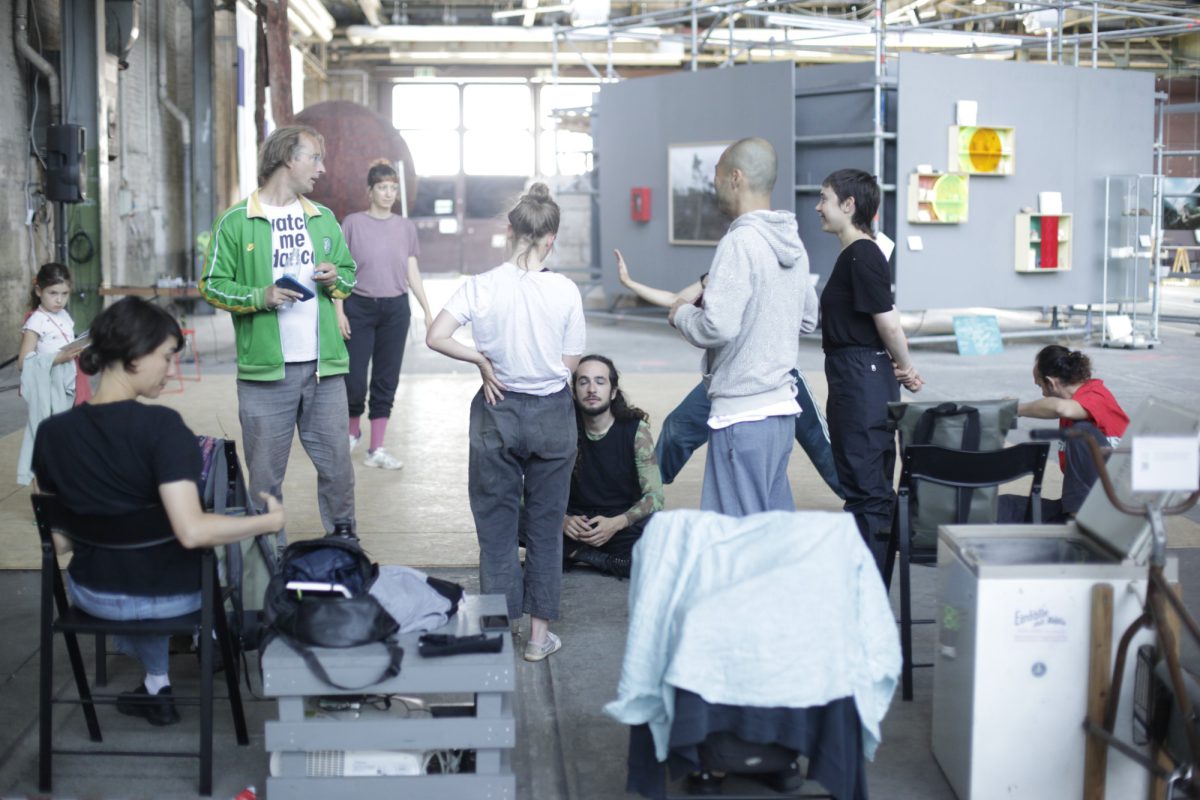
Photo: Claude Hilde / Julia Thurnau
David Brandstätter / shifts
Choreographer, composer, dramaturg and somatic researcher. David Brandstätter works between dance, sound, text and space – on stage, in public space and with people whose work has nothing to do with art.
His practice moves through four connected fields: choreographic work, fascia research, the decision field and dramaturgy.
Biography
Born in Wuppertal, Germany, in 1979, David Brandstätter grew up in Frankfurt. From the age of 15 he toured Europe as a juggler and unicyclist and practised the traditional Japanese martial art Ninjutsu. At 17 he found his way into the punk scene, became an activist at 19, and went on to study applied music science in Hamburg.
In 2001 he began studying choreography at the European Dance Development Centre in Arnhem, Netherlands (now ArtEZ), graduating in 2005. Contact Improvisation, somatic practice and real-time composition became his main choreographic tools, together with the questions that still run through his work: leadership, emancipation and resonance.
In 2007 he co-founded shifts – art in movement with Malgven Gerbes, first in Berlin and later also in Normandy, France. From 2010 to 2013 he sat on the board of ZTB, the association for contemporary dance in Berlin, discovering the beautiful dance of cultural advocacy.
In 2017 he became a father. Since 2020 he has explored how his choreographic experience can serve other contexts, such as leadership programmes, NGOs and public space, and discovered the connective tissue as a new field of research. Since 2022 he has deepened his somatic practice and meditation and has returned to making music. Since 2023 his choreographic work has increasingly moved into fine art contexts, with performances and research residencies in exhibitions and art festivals.
Today all of these strands run side by side – choreography, music, somatic research and coaching – and he enjoys the way each one feeds the others. He lives between Frankfurt, Berlin and Le Havre.
Fields of work
Choreographic work
Much of David's work can be seen as investigative choreography: he explores a subject from many angles until it finds its own choreographic and dramaturgic form, one that resonates with the subject itself. His pieces do not resolve their subjects; they zoom in on the questions that sparked them.
Humour matters to him, and so does meeting the audience at eye level: taking their questions seriously and including them in the artistic proposition as active participants. He loves working with others, especially dancers, helping them discover new aspects of themselves in relation to the subject and unfold their true potential as creators.
The forms range from installative, performative solos to documentary theatre, dance theatre and interactive installations. He is drawn to a poetic minimalism, with forms reduced to their essence and lots of space between the lines and actions, and equally to high performative intensity, where the performer's effort creates an empathic response in the audience.
Alongside his own productions, he happily works as a guest choreographer for other companies.
Fascia research
In 2020, in dialogue with Thiago Granato during the research for his solo CouRage, David discovered the fascia as a somatic template for movement: a continuous web in which everything is connected, so that movement can travel endlessly through the whole body and create a fluid inner flow.
This opened a personal somatic research. Working with the connective tissue, he noticed energies surfacing as thoughts or feelings. They became a source of movement and gestural material, and he developed an attitude in dialogue with these energies to clarify and release them.
Through meditation and somatic movement, this has grown into a more intuitive relationship with the body: tapping into these energies directly, questioning their presence and negotiating why they are there. In this way it becomes possible to resolve them and create space in the tissue for new energy to move freely through the body.
The research has led to a 3D fascia map and to a methodology for other somatic practitioners on how to access this kind of bodily knowledge, which David wants to share and develop further.
The decision field
Turning pressure into timing. The decision field is a training for navigating complexity under pressure: making the most of communication and teamwork, and finding the right moment to speak within a working environment.
Drawing on choreographic methodology, it uses exercises developed specifically for this purpose. Rather than discussing decision-making, participants experience how choices emerge, how timing can be recognised and how to act within complex group dynamics. No movement experience is needed. Physical credibility, posture and natural presence are by-products of the training.
Offered as a 90-minute introduction, half-day workshop or full-day intensive, for executives, leadership cohorts and teams working under pressure. Now open for enquiries.
Dramaturgy
David loves to accompany a story as it unfolds. For him there is a language in movement, and movement can be seen everywhere: the movement of thought, of inner motion, of public opinion, of perspective, of an eyelid or of the whole body.
Looking at movement as a storyteller, he has helped people write their grant applications, told larger stories in cultural advocacy contexts, and worked with numerous artists as an outside eye for their productions. He also works with university students of choreography and theatre.
His work as a dramaturg is less concerned with bringing in references from outside than with these questions: What movements are present? What leads to what? How do things resonate? And how can they be made visible?
Practices and passions
Music composition
David's path in music began with the violin, which he played from the age of 6 to 16. Two years of musicology in Hamburg introduced him to synthesis, music psychology and music ethnology. During his choreography studies in Arnhem he began composing on the laptop and discovered the American postmodern composers around John Cage and Morton Feldman. His early computer music was built from field recordings and their acoustic manipulation, sampling and microsampling: generative soundscapes and rhythms made from everyday objects.
After a long break, in which he dedicated himself entirely to choreography, he returned to sound design for his solo CouRage, creating the whole composition from the sounds of a folding ladder. He started playing the guitar in 2020 and has been working with synthesis since 2022.
He is inspired by electronic music as much as punk rock, traditional Korean and shamanic drumming, hip hop and experimental music, and drawn to meditative journeys as much as trance-inducing flow states. He likes complexity and radicality in his sound.
Lately he records more and more. He is thinking of publishing synthesized tracks, creating his own genre, Acoustic Shadow Work, designed to help access the fascia of the body through emotional states, and is playing with the idea of creating music for the dance floor.
Contact improvisation
David started contact improvisation in Hamburg and enjoyed it from the beginning; his background in martial arts helped him to interact with another body in real time. During his studies in Arnhem he worked for several years with the Korean student Yang Seung Hee: together they led the contact jam and met weekly to develop exercises and pieces around the technique.
In his early years he taught contact in a very physical, mechanical and practical way, focusing on its primal mechanics, somatic tuning and tricks that make the body agile and able to bear weight in any position. He then became more and more interested in the danced relationship within a contact duet. Acrobatics moved into the background as he developed strategies and techniques to keep the story and the dance active. In recent years contact has blended with his fascia work, making it even more of an energetic exchange.
For him, contact improvisation is one of the most holistic ways to communicate through the body: very effective for getting to know one another, a beautiful exercise in listening, and able to reveal the subconscious in interesting ways if one allows it. He has taught it to professional dance companies, university students of dance and choreography, professional dancers and hobbyists.
shifts – a history
shifts is an organisation for art and movement, an assembly for performance that seeks to cross between media and cultures. It adapts its artistic team and its form of expression to each project and its subject, and so keeps creating new collaborations and connections. It rests on one conviction: that constant changes of perspective, of balance and of starting point are essential to a serious and ongoing artistic practice.
David Brandstätter and Malgven Gerbes founded shifts – art in movement in 2007 in Berlin. In 2012 they founded the French association in Normandy, making shifts a French-German company. Together they created more than fifteen productions, from RENCONTRES (2007) and NOTEBOOK (2008), a choreographic journey through Korea and Japan, to FESTINA LENTE (2013) and the ODC cycle (2023–ongoing). Alongside the stage work, shifts has created many projects in public space, among them the RIM encounters in Le Havre, developed in collaboration with architects such as the collective Les Gens des Lieux, and HansaHood in Berlin (2021), as well as works for young audiences such as LES SOLS, LE LARGE and NUAGES. Associated with fabrik Potsdam (2007–2018) and Le Phare, CCN du Havre Normandie (2019–2021), the company's work has travelled across Europe, and from Seoul, Tokyo and Mexico to Shanghai, Tunis, Karachi and San Francisco.
After 22 years of artistic collaboration, Malgven and David are going separate ways: Malgven leads shifts in France, with its website at s-h-i-f-t-s.org, and David leads shifts in Germany. Future collaborations are possible, but for now both are taking time to sharpen their personal artistic profiles.
“No piece is like another in the work of Malgven Gerbes and David Brandstätter. And still, one creation after another, […] an ensemble that is both very coherent and unique.”
Thomas Hahn, Danser Canal Historique
“Here are new craftsmen of dance's reflection, taking choreographic research further.”
La Voix du Luxembourg, Avignon 2012
Collaborators
DANCE & PERFORMANCE Caroline Allaire, Nora Barna, Diana Bayardo, Vidal Bini, Lisa Bless, Katrina Brown, Sofia Casprini, Filippo Ceredi, Gervasio Cetto, Camille Chapon, Johanna Chemnitz, Katarzyna Chmielewska, Riccardo De Simone, Margot Dorléans, Michiyasu Furutani, Malgven Gerbes, Olga Gutiérrez, Katell Hartereau, Hermann Heisig, Raphael Hillebrand, Anthony Jean, Eva Karczag, Hyoung-Min Kim, Eva Kupfer, Sebastian Kurth, Aline Landreau, I-Fen Lin, Tarlie Lumby, Guillermo Magallón, Makoto Matsushima, Ixchel Mendoza Hernandez, Sybille Müller, Jou Odorujou, Elpida Orfanidou, Emilie Ouedraogo Spencer, Alan Page, Stève Paulet, Pauline Payen, Waldo Pierre, Madison Pomarico, Rebeca Portillo, Sophie Prins, Léonard Rainis, Pedro Rosa, Lyllie Rouvière, Lisa Sahores, Shen Xiny, Shenxi Song, Cary Shiu, Simone Truong, Gill Viandier, Niannian Zhou
ARTISTIC DIALOGUE & DRAMATURGY Malgven Gerbes, Uwe Gössel, Thiago Granato, Howard Katz, Katja Kettner, Mary O'Donnell Fulkerson, David Williams, Yang Seung Hee
TEXTS Martin Clausen, Chris Crickmay, Hatto Fischer, Alexandros Mistriotis, Gabriele Wittmann
GUESTS Dominique Boivin, Henda Chennaoui, Darvesh, Michelle Jaques, Alexandros Mistriotis, Bruno Pace, Juliane Rettschlag, Camille Roth
SOUND & MUSIC Brendan Dougherty, Christoph Engelke, Luigi Gaggero, Hilary Jeffery, Robyn Schulkowsky, Jim Sert, Nicolas Tinel, Ruth Wiesenfeld
LIGHT Thomas Achtner, Robin Decaux, Michael Kunitsch, Bruno Pocheron, Max Sautai, Jens Siewert, Claire Terrien, Medhi Toutain-Lopez, Ruth Waldeyer
COSTUMES Hiroaki Kanai, Heather MacCrimmon
VIDEO Julien Crépieux, Laure Delamotte-Legrand, Christoph Lemmen, Oscar Loeser, Marie Spiller
PHOTOGRAPHY Caroline Ablain, Elian Bachini, Cécile Dorléans, Bernard Hébert, Claude Hilde / Julia Thurnau, Oscar Loeser, Pascal Miet, Chris Nash, Zara Popovichi, Lisa Sahores, Max Sautai, Thorsten Wiesmann, Cezary Zacharewicz
GRAPHIC DESIGN Yoann Bertrandy
PUBLIC SPACE PROJECTS Henrik Adler, Adrienne Goehler, Dorian Guérin, HeHe duet, Les Gens des Lieux, Martin Kaltwasser (1965–2022), Dorothée Navarre Vatinel, Marc Vatinel, Emmanuelle Vo-Dinh
PRODUCTION & TOURING Clara Debour, Christine Elbel, Ann-Christin Görtz, Katja Kettner, Ireri Mugica, Frauke Niemann, Alix Pellet, Clémence Rey, Marie Ruillé
PRESS Ruth Hunsdörfer, Kathrin Schäfer
Partner institutions
Large institutions and small rooms, early supporters and recent partners: in alphabetical order, and with gratitude.
THEATRES, CHOREOGRAPHIC CENTRES & RESIDENCIES Atelier de Paris / CDCN, Beau Geste – Le Dancing, CCN – Ballet de Lorraine, CCN de Caen, CCN de Tours, CEPRODAC Mexico City, Chorège / Relais Culturel Régional du Pays de Falaise, CHU Rouen, Cité Danse Grenoble, Collectif Danse Rennes Métropole, CounterPulse San Francisco, Dock 11 Berlin, DSN – Dieppe Scène Nationale, fabrik Potsdam, Generale Oost Arnhem, Giesinger Bahnhof Munich, Jin Xing Dance Company Shanghai, Karachi American Center, Klap Marseille, Kunstraum Potsdam, La Friche la Belle de Mai Marseille, La Villette Paris, Le Moulin Louviers, Le Phare – CCN du Havre Normandie, Le Rive Gauche Saint-Étienne-du-Rouvray, Le Triangle – Cité de la Danse Rennes, Le Volcan – Scène nationale du Havre, Lofft Leipzig, Maison de l'Architecture de Normandie – Le Forum, Manufacture des Capucins Vernon, Melkweg Amsterdam, MPAA Paris, Muffatwerk Munich, MuMa – Musée d'art moderne André Malraux Le Havre, Museo Universitario del Chopo Mexico City, PACT Zollverein Essen, Pavillon-s Andé, Pôle Sud Strasbourg, Scène Nationale Evreux Louviers, Session House Tokyo, Shanghai Grand Theatre, Sophiensaele Berlin, Südpol Luzern, Tanzfabrik – Uferstudios Berlin, Tanzhaus NRW, Tanzland Stolzenhagen, Tanztendenz Munich, Theater aan de Rijn Arnhem, Théâtre de Hautepierre Strasbourg, Théâtre de la Joliette Marseille, Théâtre des Chalands, Uferhallen Berlin
FESTIVALS 48h Chrono Marseille, Ausufern Berlin, Avis de Grand Frais Caen, Bunvat Karachi, Carthage Dance Tunis, DANCE Munich, DancEmotion Ghent, Danxica Cancún, EINCE Guadalajara, Festival Croisements, Festival des Cultures Urbaines Canteleu, Gdansk Dance Festival, Herbstleuchten – fabrik Potsdam, Heure Curieuse Tours, In Between Wroclaw, June Events Paris, Kunstfest Weimar, La Danse de tous les Sens Falaise, Les Hivernales d'Avignon, Life Legacy Project – Angela Guerreiro, Made in Potsdam, Normandie Impressionniste, Open Spaces – Tanzfabrik Berlin, Ortstermin Berlin, Perspektive Innenstadt Wolfsburg, Pharenheit Le Havre, Plein Phare Out Le Havre, Potsdamer Tanztage, Rencontres chorégraphiques internationales de Seine-Saint-Denis, San Francisco International Arts Festival, TANZ Heilbronn, Tanznacht Berlin, Tanztage Berlin, Tanztausch Cologne, Temps d'Images Cluj, Tours d'Horizons, Villette Street Festival Paris, Yucatán Escénica Mérida, Zigzag Normandie
FUNDING & PUBLIC BODIES Alternative Network for the Performing Arts of Yucatán, Bezirksamt Tempelhof-Schöneberg, BLZT Performing Arts Fonds, Conseil Général de Seine-Maritime, Département de l'Eure, Dis-tanzen, DRAC Normandie / Ministère de la Culture, Élysée – Fonds franco-allemand, EU-Japan Fest, Fonds Darstellende Künste, Fonds Transfabrik, Hauptstadtkulturfonds Berlin, Kulturreferat München, Ministry of Culture and the Arts of Yucatán, Nationales Performance Netz – NPN, ODIA Normandie, ONDA, Région Normandie, Spielmotor München, Ville du Havre, Ville d'Octeville-sur-Mer
CULTURAL INSTITUTES Alliance Française de Shanghai, Centre Culturel Coréen Paris, Deutsches Kulturzentrum Klausenburg, Generalkonsulat der Bundesrepublik Deutschland Shanghai, Goethe-Institut Dublin, Goethe-Institut Karachi, Goethe-Institut Mexico City, Goethe-Institut Munich, Goethe-Institut Paris, Goethe-Institut Tunis, Institut Français Berlin, Institut Français Seoul, JDZB Berlin
UNIVERSITIES & SCHOOLS ArtEZ Arnhem, Dartington College of Arts, Dartington Hall, Falmouth University, Hochschule für Schauspielkunst Ernst Busch Berlin, HZT Berlin, Korea National University of Arts Seoul, MUDA Kunstencentrum Ghent, Seoul Institute of the Arts
PROJECT PARTNERS & SPONSORS Aquacaux, Café Ada Wuppertal, Divine Comédie, Filmkultur in Moabit, Gangway e.V., GENIUS, Ikonoclaste Wuppertal, Kahla Porzellan, Kaiser-Friedrich-Gedächtniskirche Berlin, Offen für Kultur / Hansabibliothek Berlin, Réseau Labaye, Reconnaissances CDC Grenoble, Reflex Octeville, Sennheiser