Fascia research
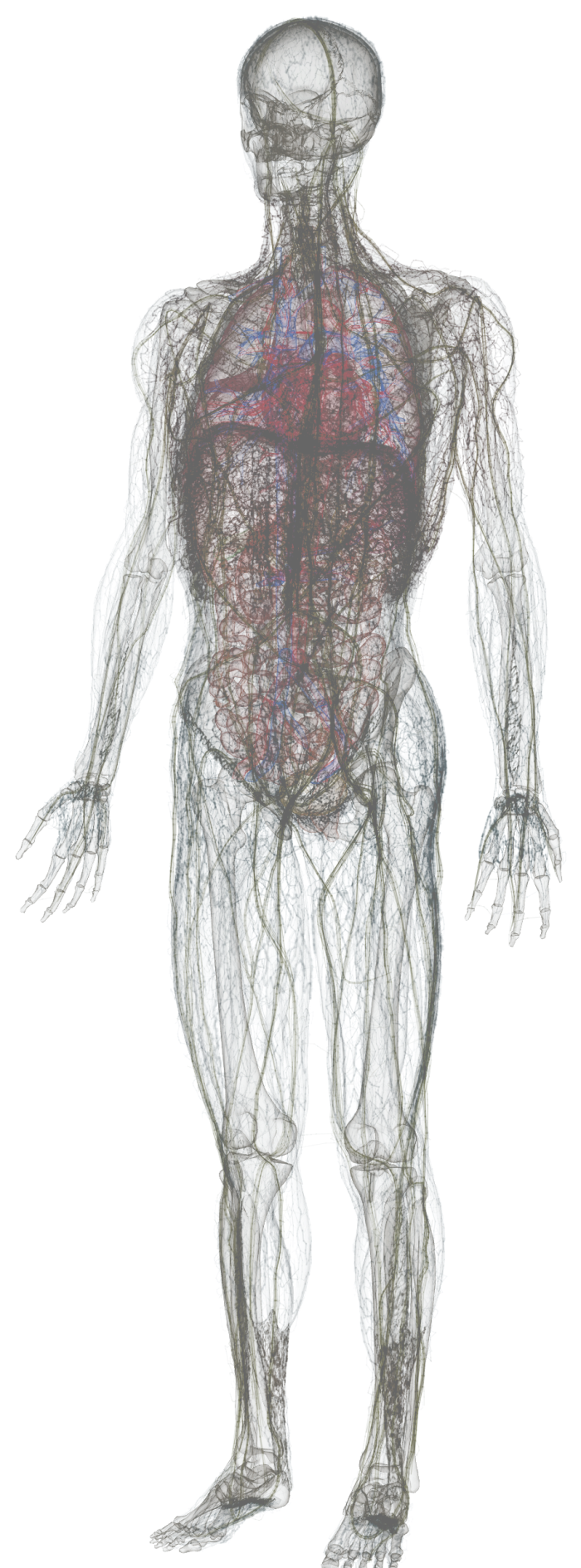
open the 3D atlas →
Since 2020, I have been exploring the fascia as a somatic template for movement: a continuous web in which everything is connected, so that movement can travel through the whole body.
What fascinates me about it, how I work with it, and the questions my research asks, unfold below.
The fascia
I like to think of the fascia as the mycelium of the body. In a forest, the mycelium links trees and plants beneath the ground and lets them exchange nourishment and signals. In the body, the fascia wraps and links every system: glands and organs, muscles and bones, vessels and nerves. Nothing in us stands apart from it.
The fascia is also one of our richest sensory organs. Woven through with nerve endings and receptors, it tells us where we are in space and how we move (proprioception), and how we are inside (interoception). According to the fascia researcher Robert Schleip, the fascial part of a muscle carries about six times as many sensory nerves as the muscle tissue itself. The fascia knows when it is under pressure, when it contracts and when it lets go.
It is not only a passive wrapping. Fascia can contract by itself, through cells called myofibroblasts, most of all in the large fascia of the lower back. Between its layers, a gel of hyaluronan lets them glide; when it thickens, the layers stick and we feel stiff. And in 2018, researchers described fluid-filled spaces held by collagen running through the whole body, overlooked for so long because preparing tissue for the microscope drained them away.
Its collagen is piezoelectric: pressure and stretch create tiny electrical charges within it, and much of living fascia is translucent.
Some experiences make me wonder how far this sensing reaches. Many sensitive people can tell, as they enter a room, that something has happened there (that people have been fighting, for instance) before a word is spoken. Many feel it when someone is staring at their back. And in boxing and other martial arts, a body sometimes answers an attack faster than the mind could decide. I suspect that the fascia is where at least our physical intuition lives. The researcher Helene Langevin has proposed that connective tissue may form a body-wide signalling network, a whole-body communication system not yet fully recognised. Hers is a hypothesis, and so is mine.
Fascia and emotion
In my work, I experience the fascia as the place where emotions enter the body. Where a feeling is first felt is not always where it stays. Shame, for example, rushes into the face in the moment it arises (we have all seen someone blush), and later it may settle somewhere else, in the pelvic floor perhaps. Feelings that could not be lived fully seem to look for a place to stay.
My somatic fascia work is a kind of shadow work, in the sense of C. G. Jung. I look for these frozen energies in the body, question them and enter into a dialogue with them: through movement, through bodily and mental attitudes, and through inner questioning in thought. I let them tell me why they are there and what they want to teach me, and whether they would leave once the lesson is learned.
I distinguish positive and negative emotions by what they do in the body. A positive emotion increases presence and flow, and deepens the resonance between the body and the world around it, other bodies included. It may vibrate in one place or through the whole body, it tends not to stay but may be cultivated, and it can help to release negative emotions. A negative emotion creates a retraction: I feel the fascia contract and tighten around the muscles. Such contractions, I believe, contribute to chronic pain and to many of the postural stereotypes we can observe in our society. Negative emotions tend to stay, like lessons waiting to be learned; yet when they come up, they often come up to offer the chance to be released.
Cultivating positive emotions, so that they resonate longer and stay, seems to me the work of a whole life, and everyone has to find out for themselves what makes their life most fulfilling. This is why my work, and The Social Body, focus mainly on the dialogue with negative emotions: so that they can make space for the positive ones to enter.
My research asks: are the places where emotions enter and settle different for each person? Where there are similarities, are they organised by the emotion itself, or by the context in which it arises: something personal or social, money or love, an issue with a father or a mother? Could we map spheres of the body in which an emotion becomes more specific?
My guess so far, and I am happy to share it as a guess: emotions induced by society, by its rules and expectations, seem to manifest more in the back of the body, while experiences that touch private and personal matters seem to sit more in the front.
These are personal and artistic reflections, and a lifetime's work in progress, which cannot be done alone. The Social Body is an invitation to participatory research: every feeling that is placed and shared on the atlas helps to see whether such patterns exist. Take part in the 3D atlas →
Thoughts, feelings and beliefs
In my experience, thoughts, feelings and beliefs act on each other in a loop. A thought may trigger a feeling, the feeling may confirm a belief, and the belief may trigger the next thought, and so on.
Take the fear of one's own success. It may rest on the belief that success would make others jealous and isolate us in society, and that belief keeps producing thoughts that feed the fear.
Belief systems are personal, yet they are also inherited, and social. Many of them come in packages, together with the roles we play in society, with archetypes and stereotypes.
I think beliefs live more in the mind than in the body. Emotions, though, live in the body, and thoughts and the beliefs beneath them can reinforce them. It also works the other way round: change a belief, and the thought changes, and with it the feeling. When I work on a feeling and ask which thoughts and beliefs are bound up with it, they come to light.
A belief can indeed change when the tissue releases, if the release is consciously connected with the thought that belongs to it: as the belief beneath dissolves, the thought dissolves with it.
The social body
With our body we receive the emotions and thoughts of others, sometimes very directly, just as we radiate our own state into the world. The room that still carries an argument is one example of it. I think of each body as porous, as part of a larger, shared body.
Science offers some clues. Moving or singing together in time brings people closer, and studies with choirs have measured more oxytocin, a hormone of bonding, after singing together than after talking together. The theory of mirror neurons suggests that watching an action stirs in us some of the same activity as doing it; how far this explains empathy is still debated. I sense something related in crowds, in a stadium or a political demonstration, when many bodies begin to resonate as one.
The Social Body, the 3D atlas, makes this tangible. Everyone can place their feelings where they sensed them and, if they wish, share them anonymously. Over time a shared map grows: a picture of where we feel what, together.
The social tissue
With our thoughts and emotions, I believe we weave a tissue between us: a social tissue that can be felt, and that extends through the fascia from one body to another, resonating.
The sociologist Hartmut Rosa describes resonance as a way of relating to the world: something touches us, we answer with our own voice, and we come out of it changed. It can never be produced on demand. Resonance needs two distinct voices: where only our own voice comes back, it is an echo; where the boundary disappears, it is fusion. And its opposite is not conflict but indifference, a world that no longer answers.
If this is so, the social tissue asks for a kind of responsibility: for what we carry into a room, into a group, into the world, and for the quality of the resonance we weave together.
We explored this responsibility in performances such as FESTINA LENTE, where the audience's counting sets the dancers in motion and every attempt depends on everyone, and ODYSSÉES IMPRESSIONNISTES, where performers and visitors shared space, attention and movement, and the work grew out of what passed between them.
Workshops
In my workshops, the fascia becomes a starting point for movement. We sense the continuous web inside us, follow how a movement travels through it, and listen to what surfaces on the way: sensations, energies, feelings. They can become movement and gestural material of their own.
The workshops are open to all levels. I teach in very different contexts, from professional dance companies and universities to open classes for amateurs. If you would like to work with me, tell me a little about yourself or your group and your background. I will let you know about the next workshops, or we can shape one together.
Inside the atlas
The atlas with its two panels: the Index of layers on the left, the information on the right (here the thoracolumbar fascia)